There’s a moment that happens to almost every first-time visitor to Lakewood, and it usually happens within the first hour of arriving.
You’re driving down Clifton Avenue, maybe a little lost, looking for the street your rental is on, and at a red light the car next to you rolls down its window. A man with a beard leans out and calls, “Good Shabbos! You need directions?” It’s Tuesday afternoon.
That’s Lakewood. And somehow, within a day or two, it starts to feel like home.
The greeting
The first thing visitors notice is that strangers talk to you here — not in the polite, distant way of a hotel lobby, but in the way of people who assume you’re mishpacha until proven otherwise. Walk down any block on a Friday afternoon and you’ll collect half a dozen “Good Shabboses” from people you’ve never met. Push a stroller past a shul on Shabbos morning and someone will nod like you’re a regular.
It’s not put on. It’s just how a town works when nearly everyone in it shares the same rhythm of life. When the whole street is walking to the same place at the same time on Friday night, the stranger next to you isn’t really a stranger.
The pace
The second thing you notice is the pace. Lakewood moves at walking speed, even when it’s busy. Yes, there’s traffic on Route 9 at rush hour — this is still New Jersey — but the town itself has a way of slowing you down. Kids on bikes. Fathers walking home from mincha with a child on each hand. Elderly couples strolling after supper like they have nowhere to be and no reason to hurry.
If you’re coming from Brooklyn or the Five Towns or anywhere with that big-city hum, the first evening in Lakewood can feel almost unnervingly calm. By the second evening, you don’t want to leave.
The sounds
Stand outside on a Thursday night and listen. You’ll hear it: the low hum of learning drifting out of a beis medrash a block away, the laughter of kids playing ball under the streetlights, someone calling “Moishe! Home!” across the street. On Shabbos afternoon, the soundtrack changes to birdsong and the murmur of families out walking — no engines, no horns, just people.
Visitors always comment on the quiet. It’s not the quiet of emptiness; it’s the quiet of a town at rest.
The invitation culture
Here’s something that surprises out-of-towners: in Lakewood, getting invited is a contact sport. Mention to a neighbor that you’re here for the weekend and there’s a decent chance you’ll be eating at least one seuda in someone else’s dining room. “Where are you eating Friday night?” isn’t small talk here — it’s a genuine question, and “we hadn’t figured it out yet” is treated as a problem to be solved, not an answer to be accepted.
Nobody finds this strange. Hachnasas orchim isn’t a program in Lakewood; it’s a reflex.
Friday afternoon
If you really want to understand the town, be here on a Friday afternoon. Around two o’clock, something shifts. The stores start closing. The streets empty of cars and fill with people walking — men hurrying home with bags of challah, kids racing home from school, everyone moving with the particular energy of people who are almost done and almost home.
The cooking smells start drifting out of windows. By candle-lighting, the whole town seems to exhale at once. And then it’s quiet, and it’s beautiful, and you understand.
Why a house changes everything
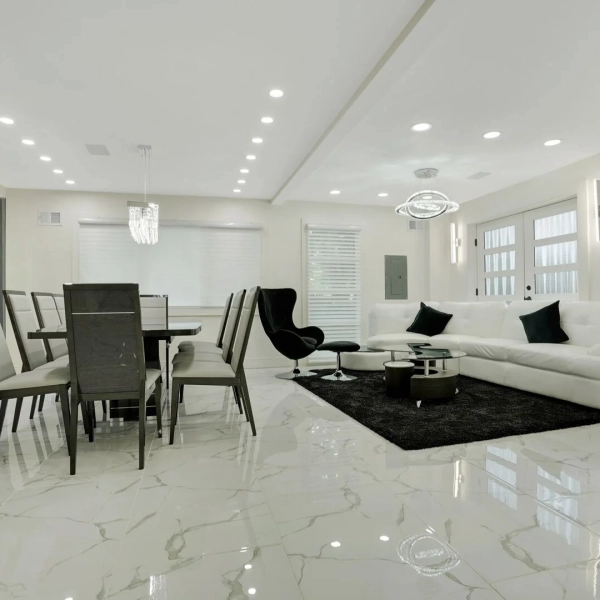
Here’s the thing about feeling at home in Lakewood: it happens fastest when you’re actually living in a house here, even for a weekend. A hotel room keeps you at arm’s length — you observe the town through glass. But a villa on a residential block puts you inside it. You’re the one borrowing sugar from next door. Your kids are the ones making friends with the kids across the street by Saturday afternoon. You’re walking to shul with the whole block on Friday night instead of watching it from a lobby.
That’s the difference between visiting Lakewood and experiencing it. One is a trip. The other feels, by Sunday morning, a little bit like coming home.
The regulars
Ask any longtime host in town and you’ll hear about the regulars — the families who came for one weekend and now come every other month. The grandparents who tried it once and now book the same weeks every year. There’s a pipeline, and it starts with that first Friday night walk.
What keeps them coming back isn’t any single attraction. It’s the cumulative effect: the greetings, the quiet, the invitations, the feeling of being known. A hotel gives you a room. Lakewood gives you a block, a shul, a pizza shop where they remember your order. After two or three visits, you’re not a tourist anymore. You’re the family from Chicago who comes for the long weekends, and people ask after your kids by name.
So come for a weekend. Walk the block on Friday night. Let a stranger wish you a good Shabbos on a Tuesday. Lakewood has a way of making visitors into regulars — and regulars into neighbors. All it asks is that you show up.